


Rule 4123:1-5-12 | Abrasive grinding and cutting, polishing and wire buffing equipment.


(A) Reserved.
(B) Reserved.
(C) Responsibility.
(1) The employer will verbally and through demonstration instruct the employee in the safe operation and maintenance of abrasive grinding and cutting and polishing equipment.
(2) It is the duty of the employee to operate such equipment in accordance with such instruction.
(D) Abrasive wheel machinery.
(1) General specifications.
(a) Machine guarding.
Abrasive wheels will be used only on machines provided with safety guards as defined in the following paragraphs of this rule, except:
(i) Wheels used for internal work while within the work being ground;
(ii) Mounted wheels, used in portable operations, two inches and smaller in diameter; and
(iii) Types 16, 17, 18, and 18R and 19 cones, plugs, and threaded hole pot balls where the work offers protection (see appendix to this rule.)
(b) Guard design.
The safety guard will cover the spindle end, nut, and flange projections. The safety guard will be mounted so as to maintain proper alignment with the wheel, and the strength of the fastenings will exceed the strength of the guard, except:
(i) Safety guards on all operations where the work provides protection to the operator, may be so constructed that the spindle end, nut, and outer flange are exposed; and where the nature of the work is such as to entirely cover the side of the wheel, the side covers of the guard may be omitted; and
(ii) The spindle end, nut and outer flange may be exposed on machines, designed as portable saws, when used with abrasive wheels.
(c) Flanges.
Grinding machines will be equipped with flanges in accordance with paragraph (D)(3) of this rule.
(d) Work rests.
(i) On off-hand grinding machines (see appendix to this rule) work rests will be used to support the work. They will be of rigid construction and designed to be adjustable to compensate for wheel wear. Work rests will be kept adjusted to a maximum opening of one-eighth inch to prevent the work from being jammed between the wheel and the rest. The employer will instruct the employee to securely clamp the work rest after each adjustment. The employer will also instruct the employee not to adjust the work rest with the wheel in motion.
(ii) The work rest will be used to support the work wherever practicable.
(e) Excluded machinery.
Natural sandstone wheels and metal, wooden, cloth, or paper discs, having a layer of abrasive on the surface are not covered by paragraph (D) of this rule.
(2) Guarding of abrasive wheel machinery.
(a) Cup wheels.
Cup wheels types 6 and 11 (see appendix to this rule) will be protected by:
(i) Safety guards as specified in paragraph (D)(2)(a)(i) of this rule, applies to paragraphs (D)(2)(a) to (D)(2)(j) of this rule;
(ii) Band type guards as specified in paragraph (D)(2)(k) of this rule; and
(iii) Special "revolving cup guards" which mount behind the wheel and turn with it. They will be made of steel or other material with strength enough to withstand the shock of the bursting wheel and will enclose the wheel sides upward from the back for one-third of the wheel thickness. The mounting features will conform with all specifications of paragraph (D) of this rule. It is necessary to maintain clearance between the wheel side and the guard. This clearance cannot exceed one-sixteenth inch.
(b) Guard exposure angles.
The maximum exposure angles specified in paragraphs (D)(2)(a) to (D)(2)(h) of this rule cannot be exceeded. Visors or other accessory equipment will not be included as a part of the guard when measuring the guard opening, unless such equipment has strength equal to that of the guard.
(c) Bench and floor stands.
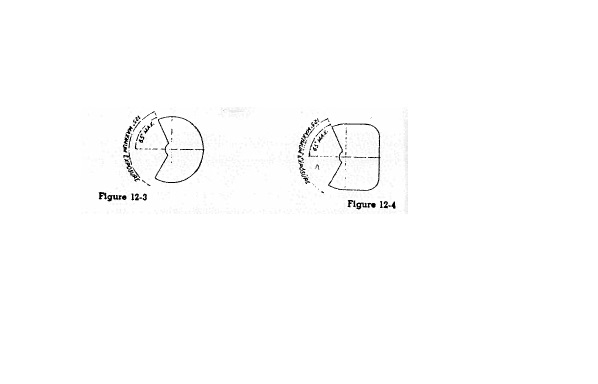
(i) The angular exposure of the grinding wheel periphery and sides for safety guards used on machines known as bench and floor stands cannot exceed ninety degrees or one-fourth of the periphery. This exposure will begin at a point not more than sixty-five degrees above the horizontal plane of the wheel spindle (see figures 12-1 and 12-2 to this rule, and paragraph (D)(2)(i) of this rule).
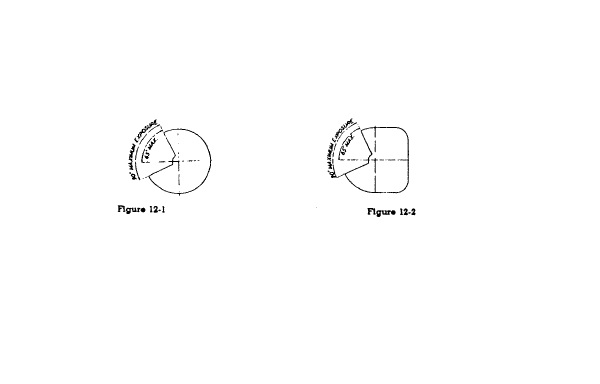
(ii) Where the nature of the work requires contact with the wheel below the horizontal plane of the spindle, the exposure cannot exceed one hundred twenty-five degrees (see figures 12-3 and 12-4 to this rule).
(d) Cylindrical grinders.
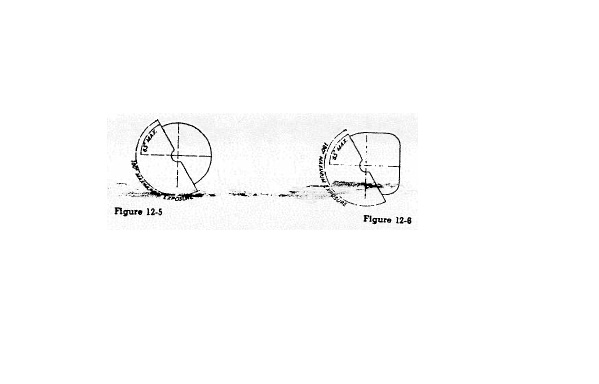
The maximum angular exposure of the grinding wheel periphery and sides for safety guards used on cylindrical grinding machines will not exceed one hundred eighty degrees. This exposure will begin at a point not more than sixty-five degrees above the horizontal plane of the wheel spindle (see figures 12-5 and 12-6 to this rule, and paragraph (D)(2)(i) of this rule).
(e) Surface grinders and cutting-off machines.
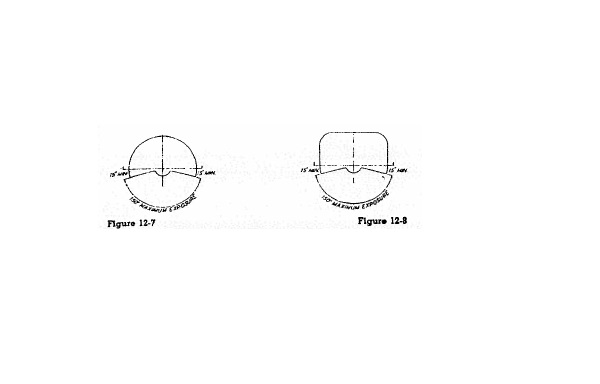
The maximum angular exposure of the grinding wheel periphery and sides for safety guards used on cutting-off machines and on surface grinding machines which employ the wheel periphery will not exceed one hundred fifty degrees. This exposure will begin at a point not less than fifteen degrees below the horizontal plane of the wheel spindle (see figures 12-7 and 12-8 to this rule).
(f) Swing frame grinders.
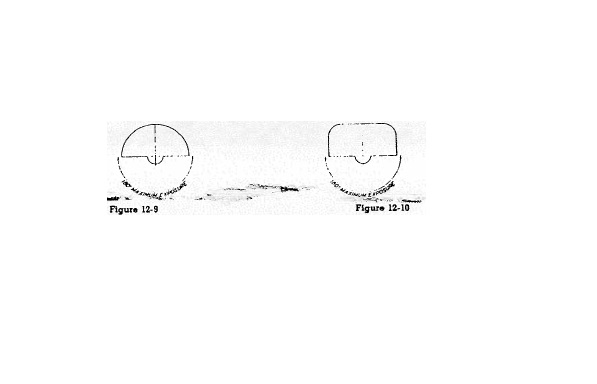
The maximum angular exposure of the grinding wheel periphery and sides for safety guards used on machines known as swing frame grinding machines will not exceed one hundred eighty degrees, and the top half of the wheel will be enclosed at all times (see figures 12-9 and 12-10 to this rule).
(g) Automatic snagging machines.
The maximum angular exposure of the grinding wheel periphery and sides for safety guards used on grinders known as automatic snagging machines cannot exceed one hundred eighty degrees and the top half of the wheel will be enclosed at all times (see figures 12-9 and 12-10 to this rule).
(h) Top grinding.
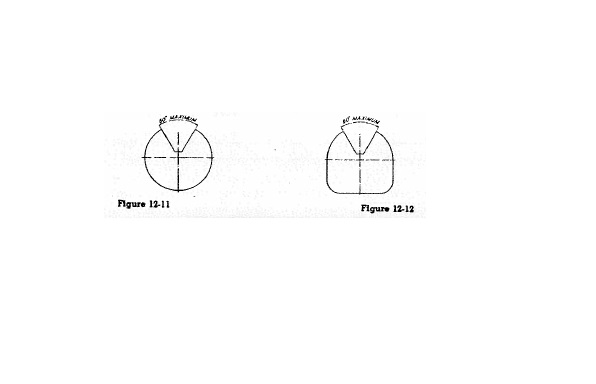
Where the work is applied to the wheel above the horizontal centerline, the exposure of the grinding wheel periphery cannot exceed sixty degrees (see figures 12-11 and 12-12 to this rule).
(i) Exposure adjustment.
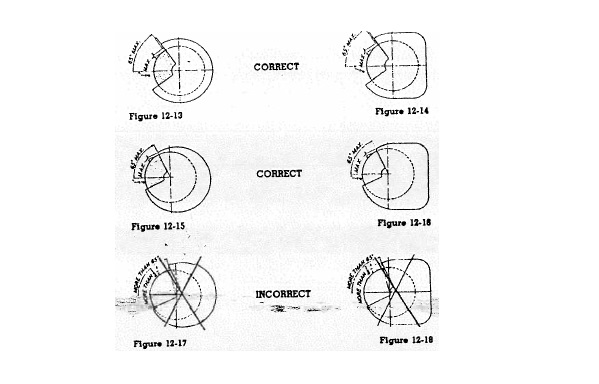
Safety guards of the type described in paragraphs (D)(2)(c) and (D)(2)(d) of this rule, where the operator stands in front of the opening, will be constructed so that the peripheral protecting member can be adjusted to the constantly decreasing diameter of the wheel. The maximum angular exposure above the horizontal plane of the wheel spindle as specified in paragraphs (D)(2)(c) and (D)(2)(d) of this rule will never be exceeded, and the distance between the wheel periphery and the adjustable tongue or the end of the peripheral member at the top will never exceed one-fourth inch (see figures 12-13, 12-14, 12-15, 12-16, 12-17 and 12-18 to this rule).
(j) Material specifications and minimum dimensions.
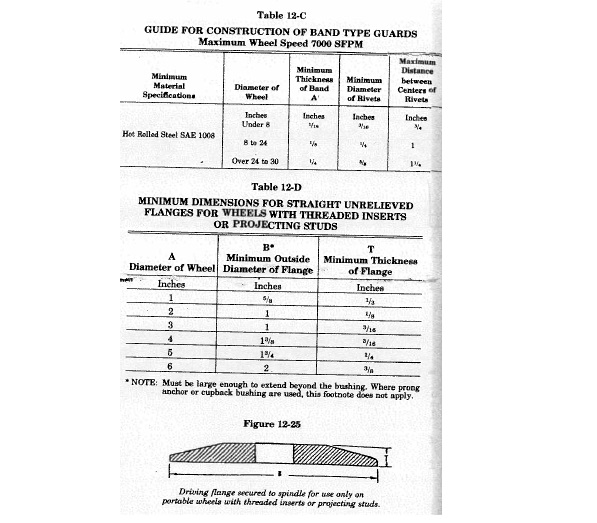
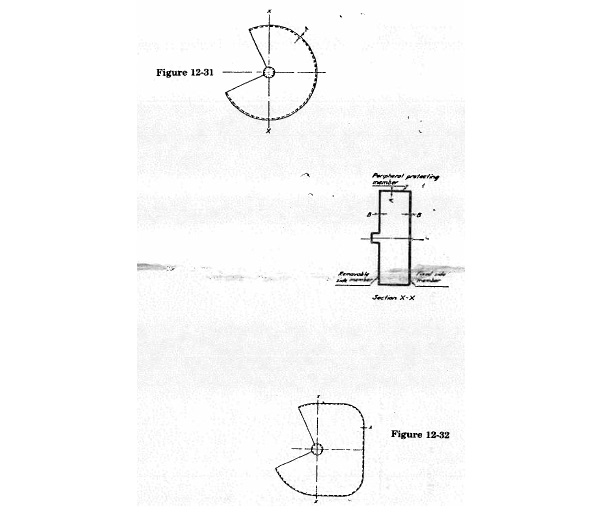
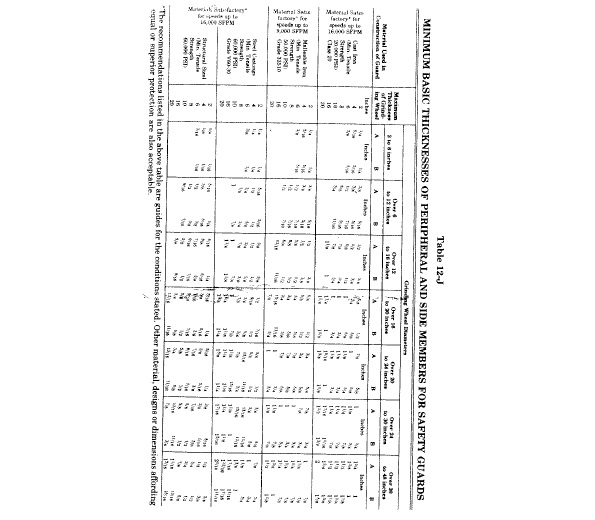
(i) See figures 12-31 and 12-32 and table 12-J to this rule for minimum basic thickness of peripheral and side members for various types of safety guards and classes of service.
(ii) If operating speed does not exceed eight thousand surface feet per minute cast iron safety guards, malleable iron guards or other guards as described in paragraph (D)(2)(j)(iii) of this rule will be used.
(iii) Cast steel, or structural steel safety guards as specified in figures 12-31 and 12-32 and table 12-J to this rule will be used where operating speeds of wheels are faster than eight thousand surface feet per minute up to a maximum of sixteen thousand surface feet per minute.
(iv) For cutting-off wheels sixteen inches diameter and smaller and where speed does not exceed sixteen thousand surface feet per minute, cast iron or malleable iron safety guards as specified in figures 12-31 and 12-32 to this rule, and in table 12-J to this rule will be used.
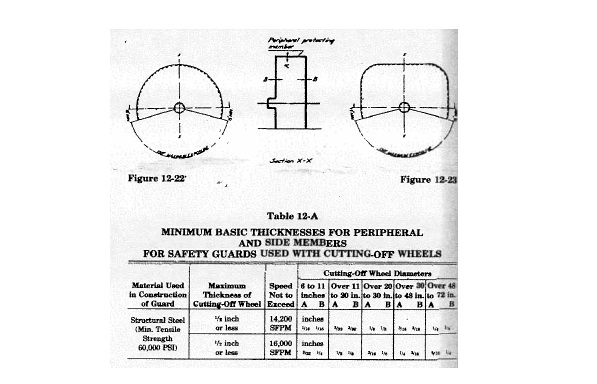
(v) For cutting-off wheels larger than sixteen inches diameter and where speed does not exceed fourteen thousand two hundred surface feet per minute, safety guards as specified in figures 12-22 and 12-23 to this rule and in table 12-A to this rule will be used.
(vi) For thread grinding wheels not exceeding one inch in thickness cast iron or malleable iron safety guards as specified in figures 12-31 and 12-32 to this rule and in table 12-J to this rule will be used.
(k) Band type guards - specifications.
Band type guards will conform to the following specifications:
(i) The bands will be of steel plate or other material of equal or greater strength. They will be continuous, the ends being either riveted, bolted, or welded together in such a manner as to leave the inside free from projections.
(ii) The inside diameter of the band will not be more than one inch larger than the outside diameter of the wheel, and will be mounted as nearly concentric with the wheel as practicable.
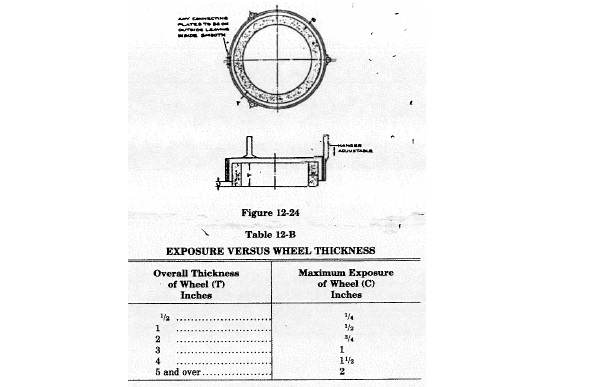
(iii) The band will be of sufficient width and its position kept so adjusted that at no time will the wheel protrude beyond the edge of the band a distance greater than that indicated in figure 12-24 and table 12-B to this rule or the wall thickness (W), whichever is smaller.
(3) Flanges.
(a) General specifications.
(i) All abrasive wheels will be mounted between flanges which are not less than one-third the diameter of the wheel.
(ii) Exceptions.
(A) Mounted wheels;
(B) Portable wheels with threaded inserts or projecting studs;
(C) Abrasive discs (inserted nut, inserted washer and projecting stud type);
(D) Plate mounted wheels;
(E) Cylinders, cup, or segmental wheels that are mounted in chucks;
(F) Types 27 and 28 wheels;
(G) Certain internal wheels;
(H) Modified types 6 and 11 wheels (terrazzo);
(I) Cutting-off wheels, types 1 and 27A (see paragraphs (D)(3)(a)(ii)(i)(i) and (D)(3)(a)(ii)(i)(ii) of this rule);
(i) Type 1 cutting-off wheels are to be mounted between properly relieved flanges which have matching bearing surfaces. Such flanges will be at least one-fourth the wheel diameter;
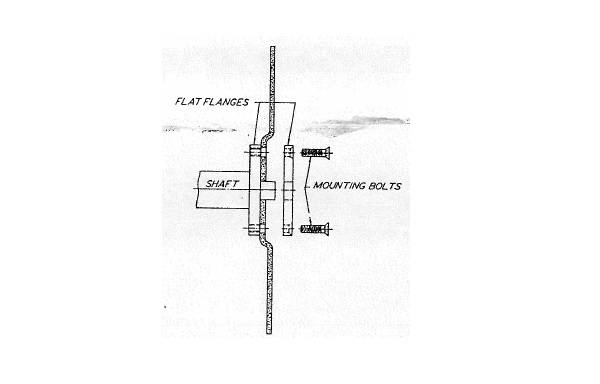
(ii) Type 27A cutting-off wheels are designed to be mounted by means of flat, not relieved, flanges having matching bearing surfaces and which may be less than one-third but not less than one-fourth the wheel diameter (see figure 12-19 to this rule for one such type of mounting);
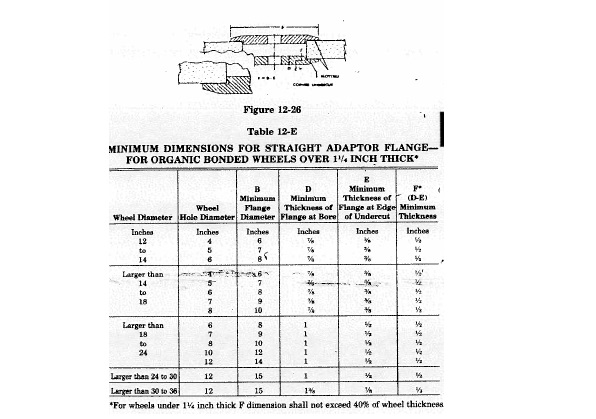
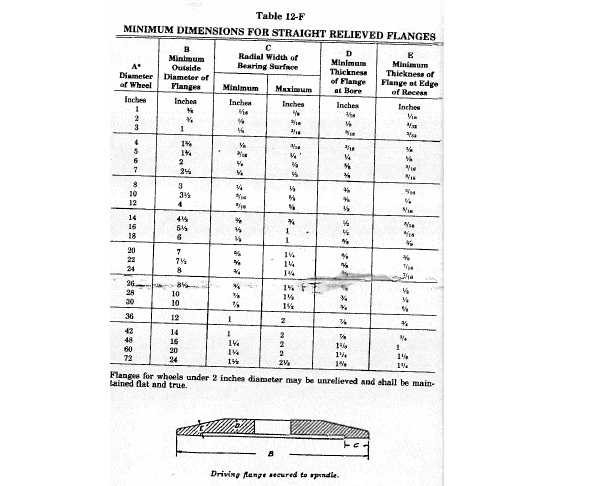
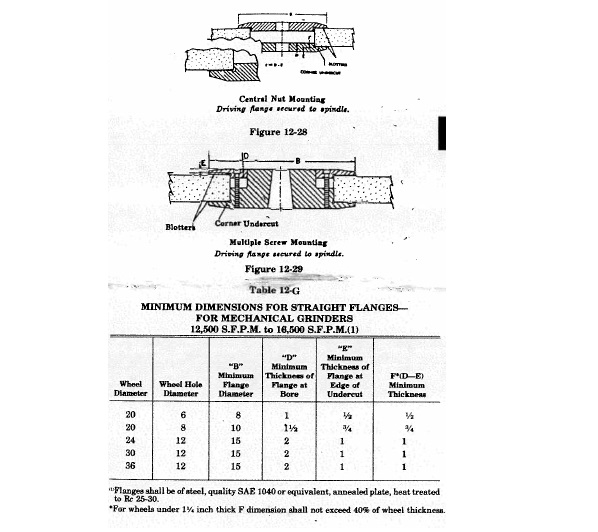
(iii) There are three general types of flanges: straight relieved flanges (see figure 12-27 to this rule); straight unrelieved flanges (see figure 12-25 to this rule); and adaptor flanges (see figures 12-28 and 12-29 to this rule);
(iv) Regardless of flange type used, the wheel will always be guarded. Blotters will be used in accordance with paragraph (D)(3)(f) of this rule.
(b) Design and material.
(i) Flanges will be of such design as to satisfactorily transmit the driving torque from the spindle to the grinding wheel.
(ii) Flanges will be made of steel, cast iron, or other material of equal or greater strength and rigidity.
(iii) Flanges will be designed with respect to rigidity so that when tightened, the radial width of bearing surface of contact on wheel is maintained (see table 12-F and figure 12-27 to this rule).
(c) Finish and balance.
Flanges will be dimensionally accurate and in good balance. There will be no rough surfaces or sharp edges.
(d) Uniformity of diameter.
(i) Both flanges, of any type, between which a wheel is mounted, will be of the same diameter and have equal bearing surface. Exceptions are set forth in the remaining specifications of this rule.
(ii) Type 27 and type 28 wheels, because of their shape and usage, need specially designed adaptors. The back flange will extend beyond the central hub or raised portion and contact the wheel to counteract the side pressure on the wheel in use. The adaptor nut which is less than the minimum one-third diameter of wheel fits in the depressed side of wheel to prevent interference in side grinding and serves to drive the wheel by its clamping force against the depressed portion of the back flange. The variance in flange diameters, the adaptor nut being less than one-third wheel diameter, and the use of side pressure in wheel operation limits the use to reinforced organic bonded wheels. Mounts which are affixed to the wheel by the manufacturer cannot be reused. Type 27 and type 28 wheels will be used only with a safety guard located between wheel and operator during use (see figure 12-19a to this rule).
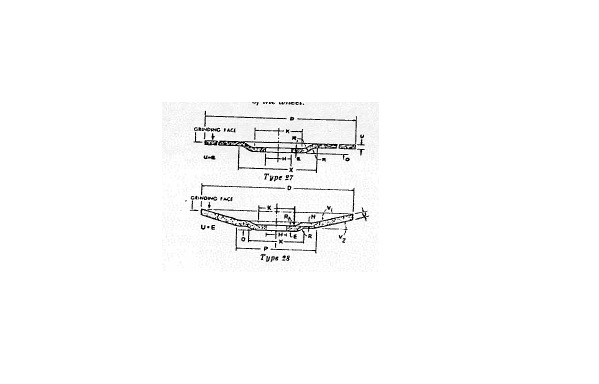
(iii) Modified types 6 and 11 wheels (terrazzo) with tapered K dimension.
(e) Recess and undercut.
(i) Straight relieved flanges made according to table 12-F to this rule and figure 12-27 to this rule will be recessed at least one-sixteenth inch on the side next to the wheel for a distance as specified in table 12-F to this rule.
(ii) Straight flanges of the adaptor or sleeve type (see table 12-G to this rule and figures 12-28 and 12-29 to this rule) will be undercut so that there will be no bearing on the sides of the wheel within one-eighth inch of the arbor hole.
(f) Blotters.
(i) Blotters (compressible washers) will always be used between flanges and abrasive wheel surfaces to ensure uniform distribution of flange pressure (see paragraph (D)(4)(e) of this rule).
(ii) Exceptions.
(A) Mounted wheels;
(B) Abrasive discs (inserted washer, and projecting stud type);
(C) Plate mounted wheels;
(D) Cylinders, cups, or segmental wheels that are mounted in chucks;
(E) Types 27 and 28 wheels;
(F) Type 1 and type 27A cutting-off wheels;
(G) Certain internal wheels;
(H) Diamond and cubic boron nitride wheels; and
(I) Modified types 6 and 11 wheel (terrazzo) - blotters applied flat side of wheel only.
(g) Multiple wheel mounting.
The driving flange will be securely fastened to the spindle and the bearing surface will run true. When more than one wheel is mounted between a single set of flanges, wheels may be cemented together or separated by specially designed spacers. Spacers will be equal in diameter to the mounting flanges and have equal bearing surfaces.
(h) Dimensions.
(i) Tables 12-D and 12-F to this rule and figures 12-25 and 12-27 to this rule show minimum dimensions for straight relieved and unrelieved flanges for use with wheels with small holes that fit directly on the machine spindle. Dimensions of such flanges will never be less than indicated and should be greater where practicable.
(ii) Tables 12-E and 12-G to this rule and figures 12-26, 12-28 and 12-29 to this rule show minimum dimensions for straight adaptor flanges for use with wheels having holes larger than the spindle. Dimensions of such adaptor flanges will never be less than indicated and should be greater where practicable.
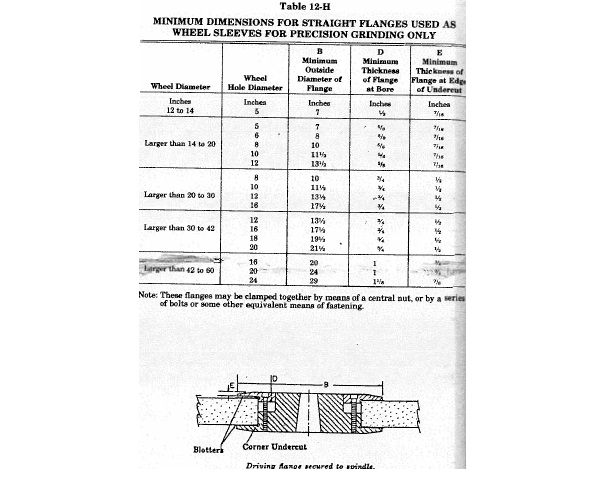
(iii) Table 12-H to this rule and figure 12-30 to this rule show minimum dimensions for straight flanges that are an integral part of wheel sleeves which are frequently used on precision grinding machines. Dimensions of such flanges will never be less than indicated and should be greater where practicable.
(i) Repairs and maintenance.
All flanges will be maintained in good condition. When bearing surfaces become worn, warped, sprung, or damaged they will be trued, refaced, or replaced. When refacing or truing, care will be exercised to make sure that proper relief and rigidity is maintained as specified in paragraphs (D)(3)(b) and (D)(3)(e) of this rule, and they will be replaced when they do not conform to these specifications and table 12-D to this rule, figure 12-25 to this rule, table 12-E to this rule, figure 12-26 to this rule, table 12-F to this rule, figure 12-27 to this rule, and table 12-H to this rule, figure 12-30 to this rule. Failure to observe these specifications might cause excessive flange pressure around the hole of the wheel. This is especially true of wheel-sleeve or adaptor flanges.
(4) Mounting.
(a) Inspection.
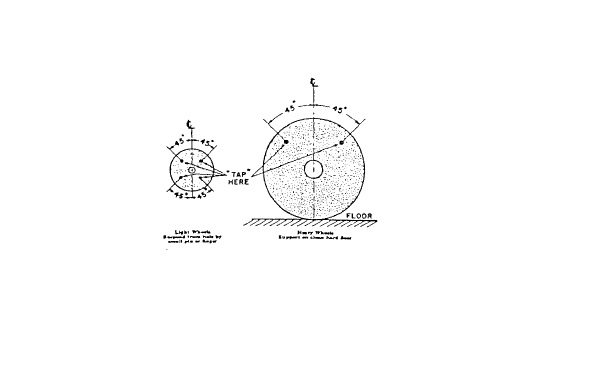
Immediately before mounting, all wheels will be closely inspected and sounded by the employer or a designated employee (ring test) to make sure they have not been damaged in transit, storage, or otherwise. The spindle speed of the machine will be checked before mounting of the wheel to be certain that it does not exceed the maximum operating speed marked on the wheel. Wheels shall be tapped gently with a light nonmetallic implement, such as the handle of a screwdriver for light wheels, or a wooden mallet for heavier wheels. If they sound cracked (dead), they will not be used. This is known as the "ring test."
(i) Wheels will be dry and free from sawdust when applying the ring test, otherwise the sound will be deadened. It should also be noted that organic bonded wheels do not emit the same clear metallic ring as do vitrified and silicate wheels.
(ii) "Tap" wheels about forty-five degrees each side of the vertical centerline and about one or two inches from the periphery as indicated by the spots in figure 12-20 and figure 12-21 to this rule. Then rotate the wheel forty-five degrees and repeat the test. A sound and undamaged wheel will give a clear metallic tone. If cracked, there will be a dead sound and not a clear ring.
(b) Arbor size.
Grinding wheels will fit freely on the spindle and remain free under all grinding conditions. A controlled clearance between the wheel hole and the machine spindle (or wheel sleeves or adaptors) is essential to avoid excessive pressure from mounting and spindle expansion. To accomplish this, the machine spindle will be made from a nominal (standard) size to plus .002 inch. A wheel which has to be forced on a spindle will not be used.
(c) Surface condition.
All contact surfaces of wheels, blotters and flanges will be flat and free of foreign matter.
(d) Bushing.
When a bushing is used in the wheel hole it will not exceed the width of the wheel and will not contact the flanges.
(e) Blotters.
A blotter will be used between the flange and the abrasive wheel. The blotter will cover the entire contact area of the flange. Blotters need not be used with the following types of wheels:
(i) Mounted wheels;
(ii) Abrasive discs (inserted nut, inserted washer, and projecting stud type);
(iii) Plate mounted wheels;
(iv) Cylinders, cups, or segmented wheels that are mounted in chucks;
(v) Types 27 and 28 wheels;
(vi) Type 1 and type 27A cutting-off wheels;
(vii) Certain internal wheels; and
(viii) Diamond and cubic boron nitride wheels.
(E) Wire buffing wheels.
Wire buffing wheels will be guarded unless the nature of the work is such that the material being processed acts as a shield to the periphery of the wheel, such as internal buffing.
(F) Polishing equipment.
(1) When dry grinding, dry polishing, or buffing is being performed, suitable hoods, or enclosures, connected to exhaust systems will be used.
(2) Such exhaust systems will be operated continuously whenever such operations are being done and shall be capable of preventing contaminants from entering the breathing zone.
Last updated June 30, 2023 at 12:20 AM
Supplemental Information